The Augmented Undercommons: A Framework for Liberatory HCI Research within Ethically Compromised Institutions
liberatory technology, HCI ethics, social justice, theory
*Recently Accepted*
Venue: ACM Conference on Human Factors in Computing Systems (CHI’26)
When: April 2026
Role: Lead Researcher
Lab: Expressive Computation Lab
Description: Sociocultural engineering research is being systematically attacked under the current US government, pressuring researchers to eliminate cultural inquiry from our work. These attacks present an existential crisis for HCI because technological innovation and understanding cultural impact are fundamentally intertwined. Marginalized HCI practitioners are at particular risk from these policies. Compliance with authoritarian demands is untenable. We need strategic, principled ways of resisting. We propose the augmented undercommons, a framework grounded in Harney and Moten’s undercommons that supports liberatory, culturally grounded technology development parallel and in opposition to ethically compromised institutions. We outline five guiding principles, demonstrate their use in HCI through four case studies, and reflect on applying the framework to our own research. The augmented undercommons builds upon past knowledge from oppressed scholars to offer one possible survival strategy for our current moment, and a call to action to reconceptualize the societal roles and responsibilities of HCI.
Liberatory Collections and Ethical AI: Reimagining AI Development from Black Community Archives and Datasets
artificial intelligence, machine learning, training datasets, archives, responsible technological development
Read the Paper Here
Venue: ACM Conference on Fairness, Accountability, and Transparency (FAccT’25)
When: June 2025
Role: Lead Researcher
Lab: Expressive Computation Lab
Description: Biases in artificial intelligence (AI) training datasets have led to models that perpetuate harmful racial stereotypes about Black communities while neglecting accurate and affirming representations of Black culture. We build on calls to create transformative technology that transcends harm mitigation–a space we categorize as liberatory technology. Within this space, we identify liberatory collections—community-led repositories that amplify Black voices— as a form of data collection that empowers and benefits communities historically harmed by traditional AI and archival practices. We survey fourteen liberatory collections, uncovering critical cultural perspectives and innovative approaches to obtaining, preserving, sharing, and valuing human information. Our findings emphasize the need for structural changes in AI training datasets and models, moving beyond representational adjustments toward strategies for creating consent-driven training models, funding community-based initiatives, and embedding Black communities’ multifaceted cultures and histories within AI systems. This research underscores liberatory collections’ potential as a framework for reimagining ethical AI development.

Lessons from AR Memorialization: Artists’ and Activists’ Approaches to Responsible AR Development
augmented reality, memorialization, responsible technology development, human-centered computing
Read the Paper Here!
Venue: ACM Conference on Designing Interactive Systems (DIS’25)
When: July 2025
Role: Co-Lead Researcher
Lab: Expressive Computation Lab
Description: Augmented reality (AR) applications are rapidly proliferating; however, we have a limited understanding of the risks of widespread AR in social settings. We seek to develop community-centered methods to implement AR ethically and responsibly. We draw on the expertise of community-centered AR practices outside of mainstream human-computer interaction by examining human rights memorialization through public AR applications. We conducted interviews with the creators of eight prominent AR memorialization projects. Through these interviews, we analyze the relationship between AR implementation and the responsible depiction of vulnerable communities. Our findings have implications for how AR developers approach data ownership and how creators can reconcile the transient qualities of AR development with documentary and storytelling objectives. We argue that AR can serve as a powerful platform for non-fiction storytelling through authoring technologies that enable community-level participation and efforts to support AR production in tandem with other forms of media and public engagement.

When: January – September 2023
Role: Executive Director
Lab: Ida B. Wells Just Data Lab
Description: A platform for technology justice practitioners and worldbuilders to connect, envision and create just futures. The Hub includes strategy sessions, speed-connecting and presentations.
Output: 2-day virtual conference with nearly 100 participants from 13 countries
Response: “I was totally blown away by some of the insights from the arts and emerging technologies session… I’m glad to see so much enthusiasm about these topics!” -Anonymous Participant

Fashioning New Worlds: Weaving Alternate Futures through Fashion Technology and Black Ingenuity
fashion-technology, Black studies, design
When: June 2022 – April 2023
Role: Sole Researcher
Description: By examining speculative fashion proposals and Black cultural approaches to clothing design and textiles, I aimed to draw attention to fashion’s profound impact on social realities. In doing so, I endeavored to challenge the values and practices that underpin these creations.
Output: Princeton Thesis Paper + Exhibition
Prizes:
The Princeton Prize in Race Relations Senior Thesis Prize, The Effron Center for the Study of America
The Peter W. Stroh ‘51 Environmental Senior Thesis Prize, The High Meadows Environmental Institute and the Program in Environmental Studies
Ruth J. Simmons Thesis Prize, Afican American Studies Department

Reimagining Education Justice: Practices and Tools for Tech Freedom Schools
edutech, freedom schools, surveillance technology
When: June – August 2022
Role: Team Lead
Lab: Ida B. Wells Just Data Lab
Description: This project bloomed from a long tradition of Black radical education, namely the Freedom Schools, which were created in 1964 as entirely new academies specifically designed for the education and advancement of Black students. We delved into the history that called for this revolutionary form of education and present-day schools, which seem to mirror similar cries. As we investigated the presence of surveillance technology in modern learning environments, we sought to uncover how— if at all— technology can be used to promote better education practices for diverse students.
Output: Conference Presentation, Civics of Technology 2022
Response: “Black College Students Are Leading the Movement to Eliminate Bias in Tech,” Word in Black
The Augmented Undercommons and the Path to the Sun
liberatory technology, Black studies, surveillance technology
When: August 2021 – April 2022
Role: Sole Researcher
Description: The augmented undercommons, developed from Fred Moten and Stefano Harney’s concept of the undercommons, is a parallel location where all who refuse to submit to technology’s watchful eye may freely reside while reconfiguring the world’s understanding of ‘innovation’ and ‘security.’ Through three distinct case studies, I uncover how digital maroons are reconstructing the design process and challenging industry standards. I also investigate the flaws that linger even in systems intended for freedom and how they amplify larger societal issues.
Output: Princeton Junior Thesis Paper + Video
Response:
“Payton Croskey: Subverting Race-based Surveillance in a Digital Age,” Tech Policy Leaders Podcast
FitzRandolph Gate Award, Princeton Research Day
Outstanding Junior Paper in African American Studies Prize, Afican American Studies Department

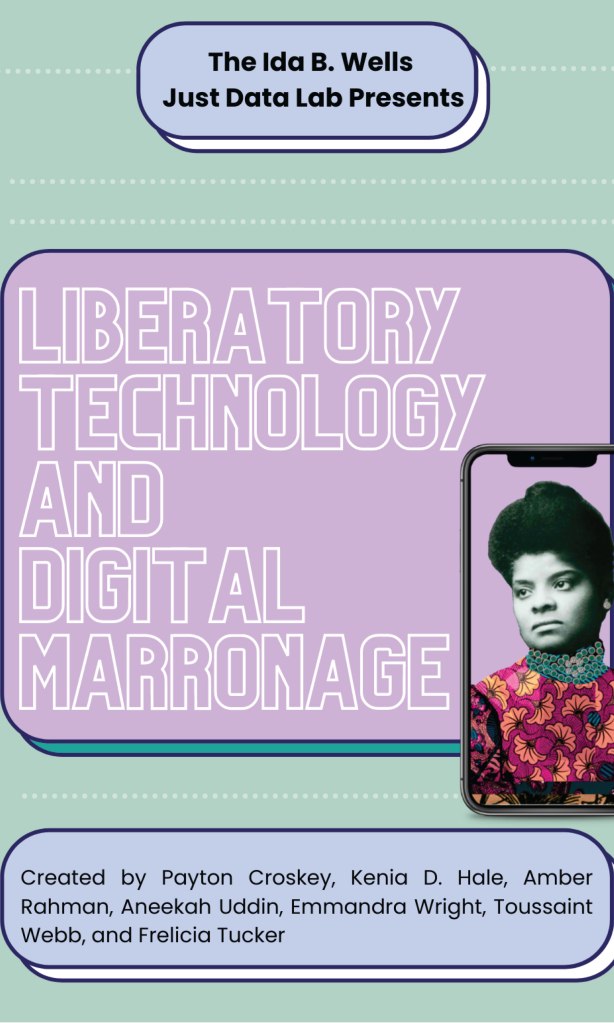
Liberatory Technology and Digital Marronage
digital repository, tech-justice, surveillance technology
When: January – April 2022
Role: Team Lead
Lab: Ida B. Wells Just Data Lab
Description: In our investigation, we delved into the development of technology centered on the principles of liberation and digital marronage, while paying respect to community knowledge. Our inquiry aimed to answer the question: how can individuals safeguard themselves from the state while preserving their ability to bask in the sunlight of life?
Each week, we selected and evaluated different types of technology and collected liberatory forms of that tool in a digital toolbox for organizers and activists.
Output: Zine + Digital Repository
Response: “How a New Generation Is Combatting Digital Surveillance,” Boston Review
The End of Privacy: Clearview AI, Mass Surveillance, & Legal Challenges
artificial intelligence, surveillance technology, participatory research
When: January – April 2021
Role: Research Associate
Lab: Ida B. Wells Just Data Lab + Mijente
Description:
This project was initiated and led by Mijente, a grassroots Latinx organization. We hoped to equip people with detailed information about this highly secretive company through an in-depth look at its technologies, employees, claims made about the company, and its clients. Through an overview of the legal challenges to Clearview, we wished to provide useful information about the legal arguments made to challenge the company and to offer a blueprint for other legal challenges people hope to pursue.
Output: Report

 Payton Croskey